
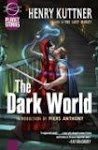

One of the things that always strikes me about the older pulp sword and sorcery stories is the use and the role of Dark Sorcery.
In D&D terms, magic is usable by good guys, and I classify this as your basic high magic that is neither good nor evil. One of the things I like about the Forgotten Realms campaign world is the definition of magic and its relationship with the weave. To me, this just makes a lot of sense. In a nut shell, the weave moves through all things, and one needs to just tap into it to work magic. Dead magic areas are locations that the weave does not go through. I am probably over simplifying it, but I think I have captured the essence of it. I am definitely a GM that likes everything to fit together well, which plays to my internal sense of an orderly reality. Magic, while outside the normal rules of physics, should be consistent when compared to itself. With that said, I do appreciate the concept that magic should be magic and not entirely explainable, which adds to the fantasy element of D&D.
Now Dark Sorcery is something else entirely. The current book I am reading is by CS Friedman, called Feast of Souls, and it was a very interesting approach to sorcery. I am actually a big fan of her work, and I really enjoyed her other fantasy trilogy, The Coldfire Trilogy. In her current book, sorcery is fueled by a person’s life force, either one’s own life force or another’s life force. This is a new spin on the idea of Dark Sorcery, which I am finding very interesting.
To me, this harkens back to the pulps, where Dark Sorcery was something evil, and with it came the corruption of men’s souls. The temptation is power, but clearly there is a price to pay. So the question becomes, how does one incorporate that into a game? With NPC’s it is easy to introduce. With players, it is a completely different story. I do want to introduce the concept of Dark Sorcery into my game as something that the bad guys use, and something that the good guys can use also, but there is a price to pay.
I have always enjoyed reading about the struggle of good characters with regards of using evil tools to defeat evil. It is the age old question of does the means justify the ends? The purists among us will clearly argue against this, but there are some that will say that the only thing that matters is the end result. To take another example, in the Eisenhorn Trilogy, we watch the puritan inquisitor come to grips with the question as he uses the tools of chaos to combat chaos.
With this in mind, I have been thinking how to create this for the characters and have the players really wrestle with this. Clearly Dark Sorcery holds power for those that embrace it, but there is a cost. The challenge is not only how to create this conflict, but how to keep the game relatively balanced regardless of the decisions that the characters make.
A couple of months ago I did a product review on Chaositech by Monte Cook, which provides a good mix of fluff and crunch on how to introduce a type of Dark Sorcery that Monte calls chaositech. Monte in his Ptolus campaigns mixes this in, and I was able to use some of it in my last campaign. I wanted to do more with it, and I am hoping to introduce it back into my next campaign, regardless of what that is. Even though Chaositech is written for 3rd edition, the concepts are clearly portable into any edition.
I have also been kicking around the idea of corruption points. I also mentioned this in an earlier blog. I really like the concept, as it allows for characters to use Dark Sorcery, but there is clearly a cost for long term usage. I think this captures the essence of what I am looking for. In my experience, just having a role playing penalty is not enough, there needs to be some sort of mechanics attached to this, as this will naturally force role playing through the decisions that the players will have to make that will ultimately affect their characters.
I will probably be blogging more on this topic, as I think it adds a dimension to the D&D game, and it is keeping with the pulp fiction roots of the game.
In D&D terms, magic is usable by good guys, and I classify this as your basic high magic that is neither good nor evil. One of the things I like about the Forgotten Realms campaign world is the definition of magic and its relationship with the weave. To me, this just makes a lot of sense. In a nut shell, the weave moves through all things, and one needs to just tap into it to work magic. Dead magic areas are locations that the weave does not go through. I am probably over simplifying it, but I think I have captured the essence of it. I am definitely a GM that likes everything to fit together well, which plays to my internal sense of an orderly reality. Magic, while outside the normal rules of physics, should be consistent when compared to itself. With that said, I do appreciate the concept that magic should be magic and not entirely explainable, which adds to the fantasy element of D&D.
Now Dark Sorcery is something else entirely. The current book I am reading is by CS Friedman, called Feast of Souls, and it was a very interesting approach to sorcery. I am actually a big fan of her work, and I really enjoyed her other fantasy trilogy, The Coldfire Trilogy. In her current book, sorcery is fueled by a person’s life force, either one’s own life force or another’s life force. This is a new spin on the idea of Dark Sorcery, which I am finding very interesting.
To me, this harkens back to the pulps, where Dark Sorcery was something evil, and with it came the corruption of men’s souls. The temptation is power, but clearly there is a price to pay. So the question becomes, how does one incorporate that into a game? With NPC’s it is easy to introduce. With players, it is a completely different story. I do want to introduce the concept of Dark Sorcery into my game as something that the bad guys use, and something that the good guys can use also, but there is a price to pay.
I have always enjoyed reading about the struggle of good characters with regards of using evil tools to defeat evil. It is the age old question of does the means justify the ends? The purists among us will clearly argue against this, but there are some that will say that the only thing that matters is the end result. To take another example, in the Eisenhorn Trilogy, we watch the puritan inquisitor come to grips with the question as he uses the tools of chaos to combat chaos.
With this in mind, I have been thinking how to create this for the characters and have the players really wrestle with this. Clearly Dark Sorcery holds power for those that embrace it, but there is a cost. The challenge is not only how to create this conflict, but how to keep the game relatively balanced regardless of the decisions that the characters make.
A couple of months ago I did a product review on Chaositech by Monte Cook, which provides a good mix of fluff and crunch on how to introduce a type of Dark Sorcery that Monte calls chaositech. Monte in his Ptolus campaigns mixes this in, and I was able to use some of it in my last campaign. I wanted to do more with it, and I am hoping to introduce it back into my next campaign, regardless of what that is. Even though Chaositech is written for 3rd edition, the concepts are clearly portable into any edition.
I have also been kicking around the idea of corruption points. I also mentioned this in an earlier blog. I really like the concept, as it allows for characters to use Dark Sorcery, but there is clearly a cost for long term usage. I think this captures the essence of what I am looking for. In my experience, just having a role playing penalty is not enough, there needs to be some sort of mechanics attached to this, as this will naturally force role playing through the decisions that the players will have to make that will ultimately affect their characters.
I will probably be blogging more on this topic, as I think it adds a dimension to the D&D game, and it is keeping with the pulp fiction roots of the game.

